


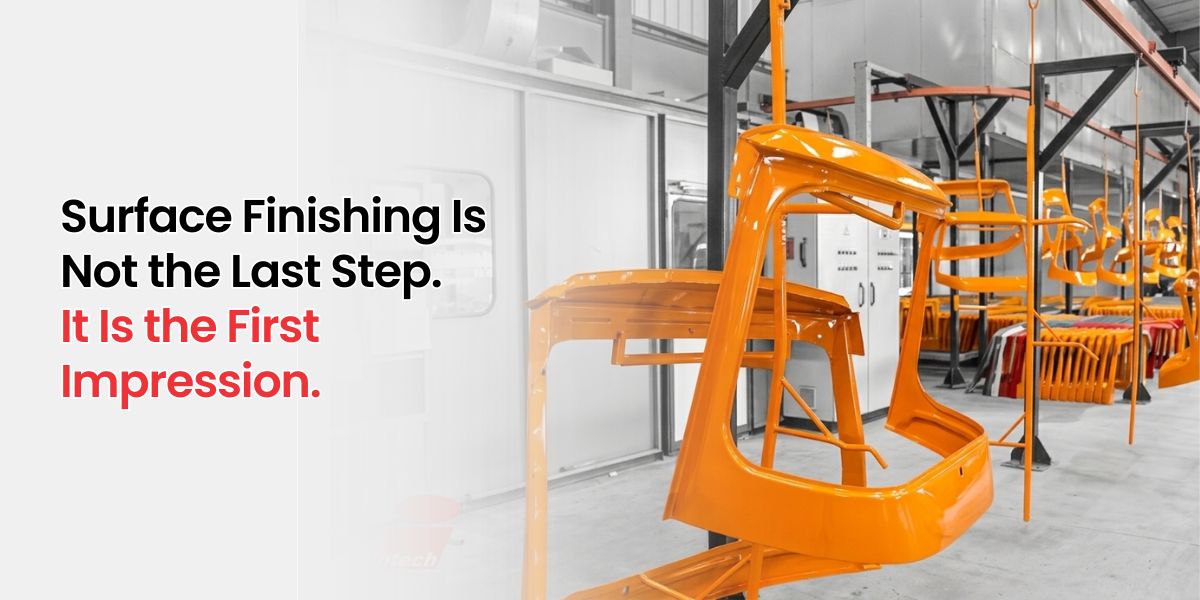
A product can be perfectly manufactured. The dimensions may be right. The design may be strong. The performance may be tested. The packaging may be ready. But when the customer sees the product, the first thing they usually notice is not the engineering inside. They notice the surface.
A patchy finish, uneven colour, scratches, dullness, or coating marks can immediately change the way a product is perceived. Even if the product performs well, a poor finish can create doubt. This is why surface finishing should not be treated as a final activity to be completed in a hurry. It is a critical part of product value.
The Finish Speaks Before the Product Does
In manufacturing, a lot of hard work happens behind the scenes. Material selection, fabrication, machining, process control, inspection, and testing all contribute to the final product. But the customer may not see all of this effort directly.
What they do see is the finish.
A clean and consistent finish creates confidence. It suggests care, discipline, and control. It gives the product a premium and reliable appearance. On the other hand, an inconsistent finish can make the customer question the overall quality, even when the product is technically correct.
That is why finishing is not only about appearance. It is about trust.

Small Finish Issues Can Create Big Delays
A finishing issue may look small at first. But on the shop-floor, it can create a chain reaction. A part may need rework. A batch may need rechecking. Dispatch may get delayed. Extra manpower, energy, powder, time, and supervision may be required.
This affects more than quality. It affects production planning, delivery commitments, and customer confidence. In many cases, the cost of a finishing problem is not limited to the rejected part. It also includes the time lost in correcting it.
This is why surface finishing needs to be viewed as a business-critical process, not just a cosmetic stage.

Good Finishing Starts Before Coating
The final finish is not decided only inside the spray booth. It depends on the complete process before and after coating.
Surface preparation, pre-treatment, drying, powder application, curing, handling, unloading, and inspection all influence the final result. If any one stage is unstable, the finish can suffer. The defect may be visible at the end, but the cause may have started much earlier.
A strong finishing system is one where every stage works together. When the process is planned well, the result becomes more consistent and predictable.
Consistency Builds Customer Confidence
One good-looking product is not enough. The real challenge is to deliver the same finish again and again across shifts, batches, operators, and product variations.
Consistent surface finishing shows process maturity. It tells the customer that quality does not depend on luck or last-minute correction. It depends on a controlled system.
The finish may come last in the production sequence, but it comes first in customer perception.
Surface finishing protects product value, delivery confidence, and brand impression. So, it should not be treated as the last step to complete. It should be treated as a key stage that decides how the product is seen, trusted, and accepted.
If you are planning a new coating line or improving an existing finishing process, start by looking at the complete system – not just the coating stage.
Build the finish right, and the product speaks better before anyone explains it.