


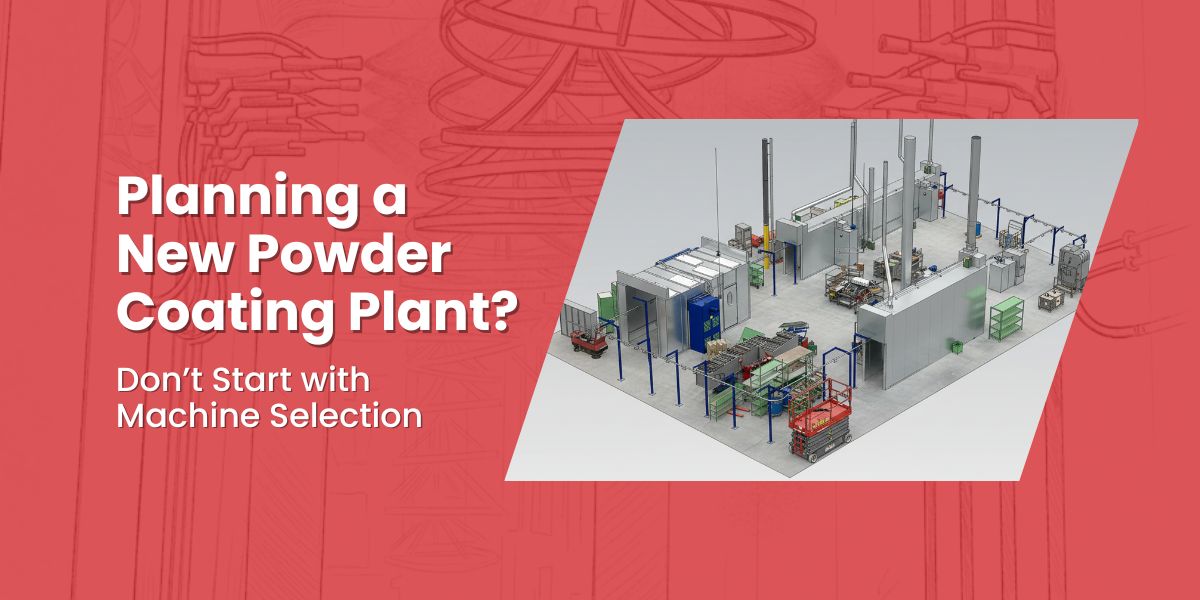
A new powder coating plant usually begins with excitement.
A new facility is coming up. Production needs to increase. Customers are asking for better finish quality. The team wants faster output, fewer rejections, and better control. Very soon, the discussion moves to machines.
How many spray guns should we use? What should be the oven size? Should the booth be manual or automatic? How much automation should we add? Which quotation looks better?
These questions are important. But they should not be the first questions.
Since a powder coating plant is not just a set of machines. It is a complete production system and a good production system does not start with equipment selection. It starts with understanding what the factory really needs to achieve.
Start with the Component, Not the Catalogue
Every coating plant should begin with one basic question. What exactly are we going to coat?
This decides almost everything.
A small sheet metal part does not need the same plant design as a heavy fabricated component. A simple flat part does not behave like a part with bends, cavities, corners, and difficult surfaces. A high-volume product does not need the same handling system as a low-volume, high-variety product.
Component size, weight, geometry, surface condition, production volume, finish expectation, and product variation all influence plant design. If this study is missed, wrong decisions may follow.
The conveyor may not support the load. The booth may not give proper access. The oven may not cure the part uniformly. The layout may create unnecessary movement. The line may become difficult to operate every day.
That is why machine selection should come later. The component study should come first.
Capacity on Paper Is Not Shop-floor Output
Capacity is usually discussed early. How many parts per hour? How many components per shift? These numbers matter. But capacity on paper can be misleading.
Parts may not reach the line on time. Loading may take longer than planned. Pre-treatment may slow down the flow. The coating booth may need frequent manual correction. Curing time may not match conveyor speed. Unloading may become crowded.
So the better question is not only: “How much can this plant produce?”
The better question is: “Can the entire process support that output smoothly?”
A good powder coating plant is not only about speed. It is about flow.
Pre-treatment and Layout Decide More Than We Think
Many coating defects are noticed after powder application. But many of them begin much earlier. Oil, dust, rust, moisture, poor cleaning, wrong chemical process, poor rinsing, or improper drying can all affect the final finish. Later, the team may blame the powder, gun, booth, or operator. But the real problem may have started in pre-treatment.
Layout is equally important.
A good layout improves material movement, operator comfort, safety, maintenance access, loading, unloading, and future expansion. A poor layout creates daily friction, even if the machines are good.
That is why pre-treatment and layout are not side decisions. They are central to plant performance.
And this is where experienced system-level engineering companies becomes critical. They not only focus on supplying coating systems, but on understanding how the entire process behaves during real production conditions. Because the goal is not simply to install a running line. The goal is to create a system that continues performing efficiently as production grows, demand changes, and operational pressure increases.
Automation Should Solve the Right Problem
Automation is useful when it solves a real production challenge.
It can improve consistency. It can reduce operator dependency. It can increase output. It can make the process more repeatable. But automation should not be added only because it looks advanced.
The right question is:
What problem should automation solve?
High volume? Finish consistency? Manpower dependency? Repeatability? Future scalability?
The best coating plant is not always the most automated one. It is the one where automation is applied at the right place, for the right reason.
A powder coating plant should not begin with: “What machines should we buy?”
It should begin with: “What production performance do we want to create?”
Because the real value of a coating plant is not in individual machines. It is in how those machines are planned, connected, and engineered into one reliable process.
So before selecting machines, select the right thinking. That is where a good powder coating plant really begins.