

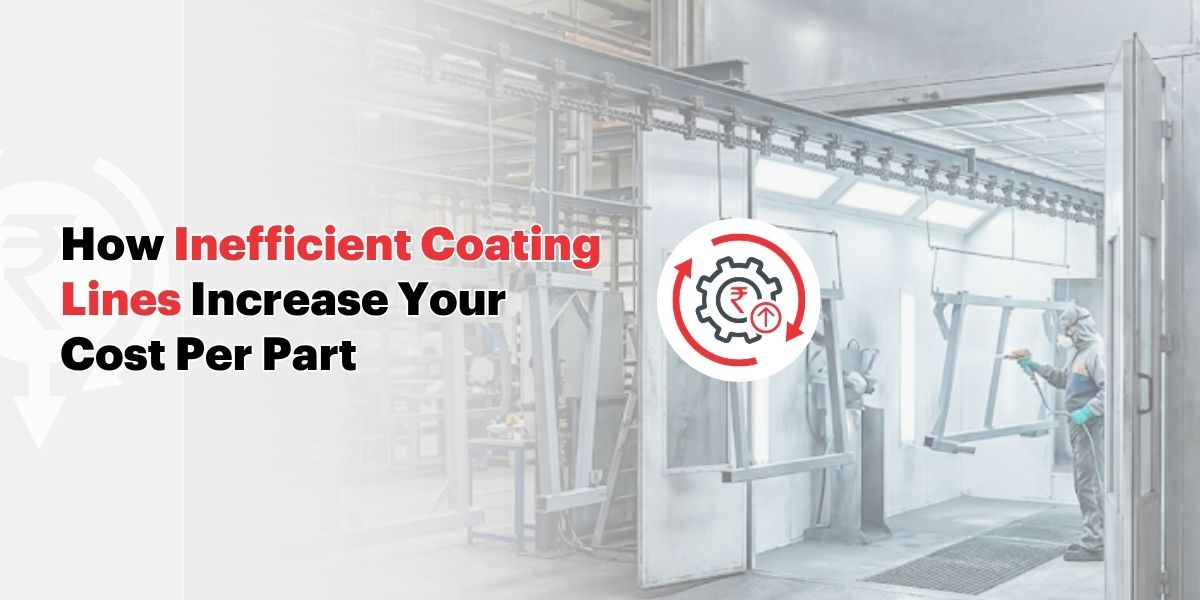
For months, everything looked normal on the shop floor. The coating line was running throughout the day. Operators were busy. Production targets were somehow being met. From the outside, the system appeared active and productive.
Yet something didn’t feel right.
Every month, the margins were tightening. Power consumption felt higher than expected. Rework had slowly become “part of the process.” Deliveries were becoming harder to manage, even though the team was working just as hard – sometimes harder.
At first, the assumption was simple: rising market costs. But the deeper they looked, the clearer it became. The real issue wasn’t outside the factory. It was happening quietly inside the coating line itself.
Most coating lines don’t suddenly become inefficient overnight.
The change is gradual. A few extra minutes lost during handling. Small delays before curing. Slightly uneven movement between stages. Components waiting longer than they should. Rework that seems manageable in isolation. Individually, these things don’t look serious.
But when they repeat every single day, they slowly begin affecting the entire operation and that is where the actual cost per part starts increasing, because coating cost is not decided only by powder consumption or electricity usage. It is heavily influenced by how smoothly the entire system performs.
An efficient coating line does not depend on constant intervention.
It does not require operators to continuously “manage problems” during production. Instead, it creates stability. Material moves smoothly. Processing stages remain balanced. Timing stays controlled. Output becomes predictable. And when a system operates with that level of consistency, something important happens: The cost per part naturally starts reducing. Not because corners were cut. Not because production was forced harder. But because inefficiencies were removed from the process itself.
This is why coating line design cannot be approached as just an equipment purchase. A coating system performs well only when the entire process is planned as one connected flow. That includes:
- Material movement
- Stage balancing
- Capacity planning
- Future scalability
And this is where experienced system-level engineering companies becomes critical. They not only focus on supplying coating systems, but on understanding how the entire process behaves during real production conditions. Because the goal is not simply to install a running line. The goal is to create a system that continues performing efficiently as production grows, demand changes, and operational pressure increases.
Many manufacturers try to reduce coating cost by focusing only on visible expenses.
But often, the bigger savings come from improving what happens between the stages – where delays, imbalance, and repeated inefficiencies quietly increase operational cost every day. And that’s what makes coating line efficiency so important.
Not just for smoother production. But for long-term profitability.
Measure your cost per part regularly…Make sure your system is perfectly designed and not just assembled.
Work with partners who understand the entire coating process – not just equipment.