

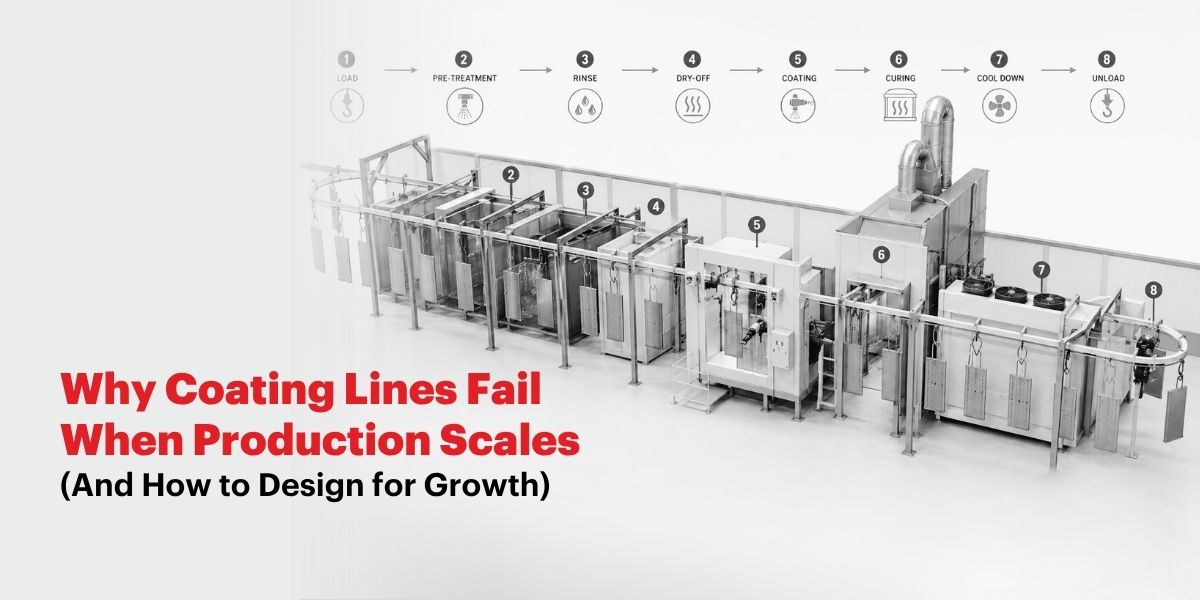
Ravi had just secured his biggest order yet. For months, his coating line had been running smoothly. Quality was consistent. Output was stable. Everything felt under control. So, when the new order came in, doubling production seemed like a good problem to have.
But within weeks, things started to change.
At first, it was subtle. A slight delay before the coating booth. A few parts waiting longer than usual. But it was ignored, as it was minor. But then the signs became clearer.
The conveyor began showing gaps. Operators were waiting more often. Rework started increasing. And most importantly – output didn’t double… even though effort did.
What really went wrong
Ravi didn’t have an equipment problem. He had a system problem. His coating line was designed for a certain load, but not for scale. As production increased, the curing stage couldn’t keep up. Line speed became inconsistent. Flow between stages started breaking down. The system that once looked efficient was now exposing its limitations.
That’s when Ravi realized something important. This wasn’t about adjusting a few settings or replacing a machine. It was about how the entire coating line was designed.
What really makes a coating line work at scale
A coating line is not just a combination of machines. It is a connected system, where every stage influences the next. When production increases, even small imbalances start affecting the entire flow
Material Movement – Material movement is the backbone of any coating line. If parts are not moving smoothly from one stage to another, delays begin to build. What looks like a minor pause at one stage slowly turns into waiting, congestion, and lost output across the line.
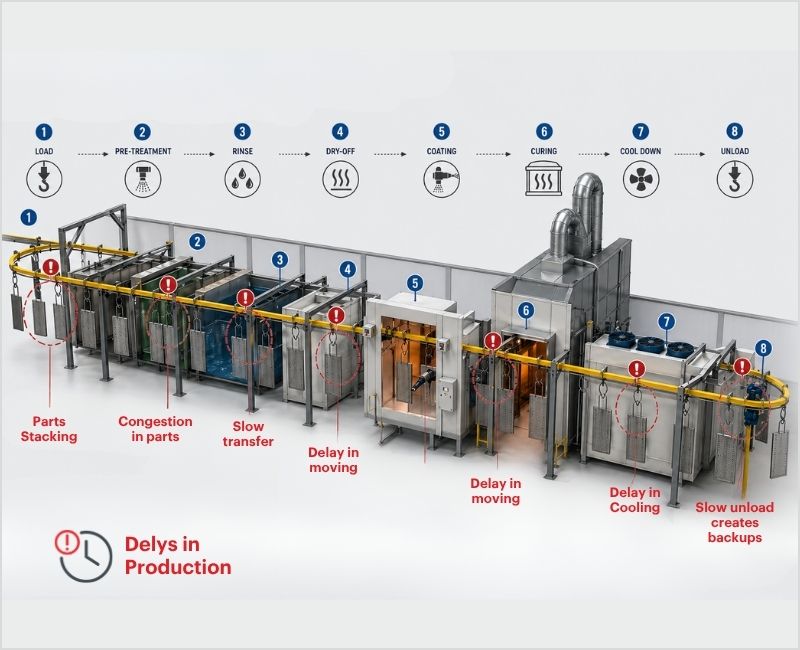
Timing – Each stage, pre-treatment, drying, coating, curing, has a specific role and a required duration. If timing is not aligned, some stages finish too early and others take longer than expected. This mismatch creates inconsistency, affecting both productivity and quality.
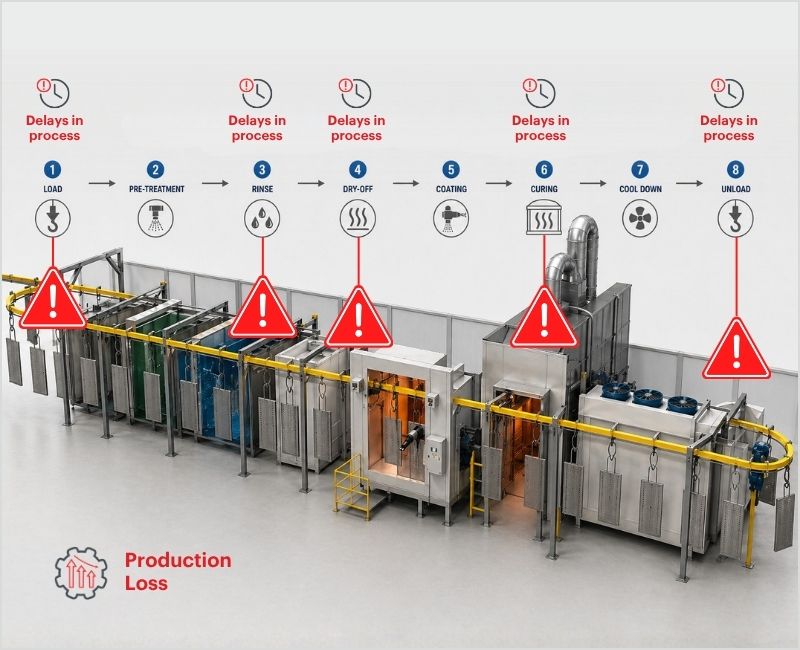
In a properly engineered system, timing is not guesswork – it is defined, tested, and synchronized.
Balance – Even with the right equipment and timing, a coating line can fail if it is not balanced. If one stage is slower than the others, it becomes a bottleneck. Everything behind it starts waiting.
Balance ensures that every part of the system moves at a compatible pace, maintaining flow and stability.
Scalability – Many coating lines are built for current requirements. But when demand increases, limitations start appearing, like Capacity constraints, space issues and process mismatches
A scalable system is designed with future demand in mind. Not just to handle today’s load, but tomorrow’s as well.
System-level engineering
This is where Intech Surface Coating Pvt Ltd make a difference. Instead of focusing only on equipment, the approach is to understand
- How the entire process flows
- Where inefficiencies can develop
- How the system will behave as production increases
From line layout and process design to balancing and optimization, the goal is to build a coating line that performs consistently, not just initially, but over time and at scale.
When a coating line is designed with this level of clarity: flow becomes smooth, output becomes stable, quality becomes consistent and most importantly – performance becomes predictable.
Planning to scale your coating operations?
Make sure your system is designed not just for today but for tomorrow.
Work with partners who understand the entire coating process – not just equipment.