

The Shop-floor Was Always Active.
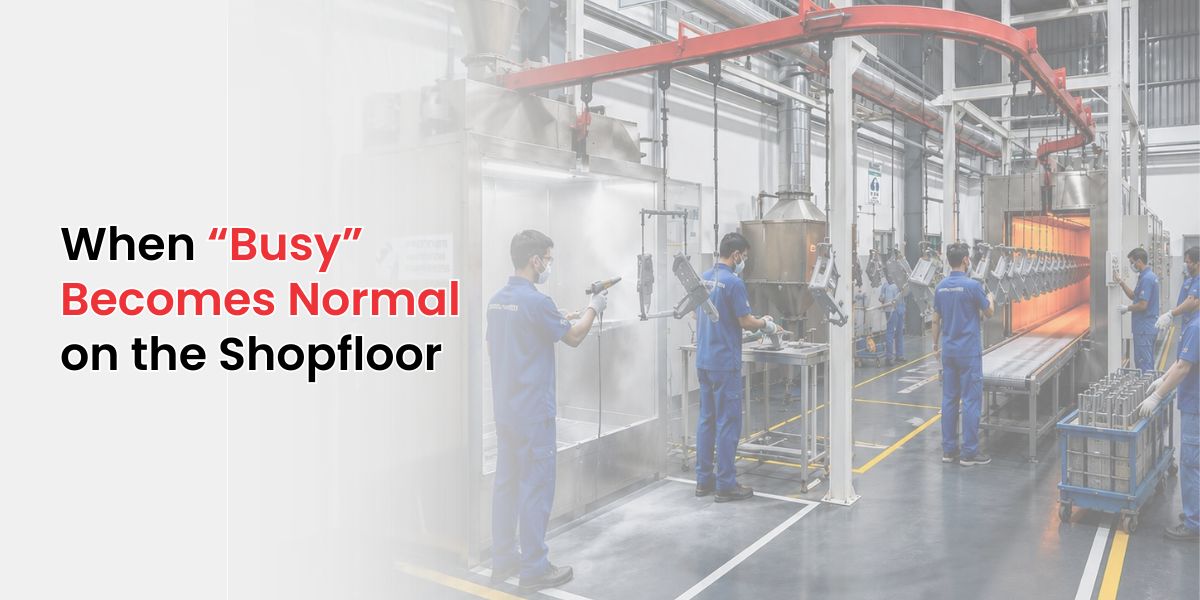
Every morning, the coating line started the same way. Operators moved quickly between stages. Supervisors continuously checked progress. Components kept entering the system. Machines rarely stopped running. From the outside, the shop-floor looked productive. But by the end of the shift, the same questions kept returning:
Why does production still feel under pressure?
Why do small delays keep affecting output?
And why does the entire operation depend on constant follow-up just to stay on track?
Over time, the team had unknowingly accepted “busy” as normal.
Activity and Productivity Are Not the Same
This is something many manufacturing facilities experience.
The shopfloor remains active throughout the day. More movement. More adjustments. More manual handling. More coordination between stages and because the line never completely stops, the system appears functional.
But constant activity does not always mean efficient production.
In many coating lines, excessive movement is actually a sign that the process is struggling to stay balanced.
The system keeps running but only because people are continuously managing the gaps manually.
The Pressure Usually Starts Small
Most operational instability doesn’t begin with a major breakdown. It starts with smaller issues that slowly become routine.
A slight waiting period before curing. Uneven movement between stages. Operators repeatedly adjusting the same process. Supervisors constantly following up to avoid delays.
Initially, these problems seem manageable. But when they repeat every day, they begin affecting much more than output.
The entire production environment changes.
Operators become dependent on constant intervention. Supervisors spend more time firefighting than improving processes. And eventually, the system starts relying more on effort than stability.
What Efficient Coating Lines Feel Like
A stable coating line creates a very different shop-floor experience.
There is less confusion. Less urgency. Less dependency on continuous correction. Material moves smoothly through the process. Stages remain balanced. Operators focus on production instead of constantly solving problems during the shift and that stability directly influences consistency, output, rework reduction, and delivery reliability.
Efficient systems don’t just improve productivity.
They reduce operational pressure across the entire shop-floor.
Why Good Systems Reduce Daily Firefighting
One of the biggest misconceptions in manufacturing is believing that daily production pressure is unavoidable.
In many cases, that pressure is created by system imbalance. When coating lines are not properly planned, synchronized, or balanced, the burden shifts onto operators and supervisors to keep production moving manually. That may work temporarily. But over the time, it increases fatigue, inconsistency, and operational dependency.
A well-designed coating line should reduce the need for constant intervention – not increase it.
And this is where experienced system-level engineering companies becomes critical. They not only focus on supplying coating systems, but on understanding how the entire process behaves during real production conditions. Because the goal is not simply to install a running line. The goal is to create a system that continues performing efficiently as production grows, demand changes, and operational pressure increases.
The Real Question Manufacturers Should Ask
Many manufacturers evaluate coating line performance by asking: “Is the line running?”
But the more important question is: “How much effort is required every day just to keep it running smoothly?”
Because the healthiest production environments are not the busiest ones.
They are the ones where the system performs with stability, predictability, and balance.
When “busy” becomes normal on the shop-floor, inefficiencies often stop looking unusual.
But efficient coating systems create a different kind of environment, one where production flows with better control, fewer interruptions, and less daily pressure.
The goal of a coating line is not just to keep production moving. It is to make production perform consistently and efficiently over the long term.