


Buyers planning a powder coating line usually spend their attention on the booth and the oven. Pretreatment gets treated as the tank at the start of the line, a formality before the real work begins.
That order is backwards. Powder coating has no adhesion or corrosion resistance of its own. The metal has to be clean and chemically prepared first, or the coating fails from underneath months after the part has shipped.
The coating only looks as good as the surface it was applied to.
What pretreatment does
A pretreatment line runs a component through degreasing, a rinse, a conversion coating stage (iron phosphate or zirconium-based chemistry is standard now, straight phosphating still common on heavier steel), another rinse, and often a passivation stage. Skip degreasing and the phosphate layer won’t bond. Skip the conversion stage and the coating has nothing to grip beyond bare metal.
The two ways to run those stages, spray and dip, come down to your components, not which system is newer.
Spray or dip: it depends what’s going through the line
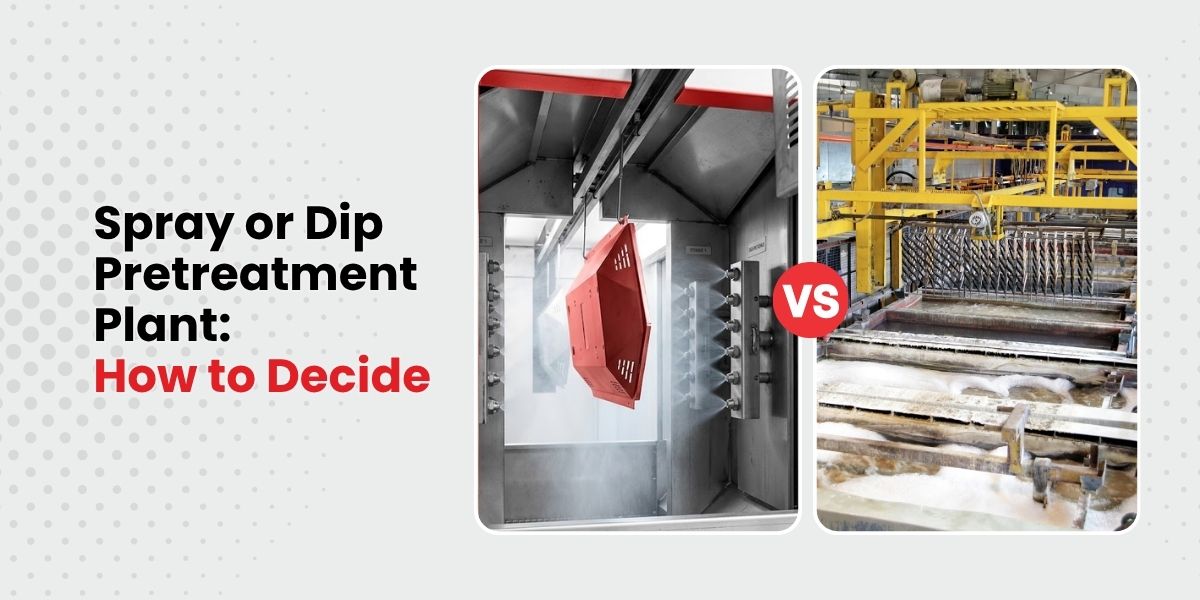
A spray plant moves the component through a tunnel while chemical solution is pumped through nozzles at each stage and recirculated. It suits parts that hang on a conveyor hook and drain freely: panels, brackets, sheet metal, most furniture components. It’s fast and efficient with chemistry, but geometry is the limit. Blind holes, deep recesses, and box-like structures have zones a nozzle can’t reach at the right angle, and those zones fail even though the outside looks clean.
A dip plant submerges the component fully in each bath, usually on a PLC-controlled hoist. Every surface gets contact time, including internal cavities and folded seams a nozzle can never line up on. That thoroughness costs cycle time and tank footprint, since each bath has to fit the largest component going through it. Dip fits automotive components, hollow fabricated assemblies, and mixed-geometry job shops.
Before choosing, check
Do your parts have blind holes or box sections that trap air or liquid?
Can they hang and drain cleanly, or do they need full immersion?
How much floor length can you spare for pretreatment versus the booth and oven?
A furniture maker running flat brackets and an automotive supplier running hollow weldments aren’t choosing between the same two options, even though both are technically picking between spray and dip.
Skipping pretreatment isn’t an option at production volumes. Powder over bare or inconsistently cleaned metal has no real bond to the substrate, and it fails under humidity or thermal cycling far sooner than a properly treated surface. The cost of pretreatment is a line item. The cost of skipping it is a warranty claim later.
Intech builds both spray and dip pretreatment plants in-house, sized to the components and throughput of the line they sit in. Talk to Intech Surface Coating about which configuration matches what you’re running through it.