


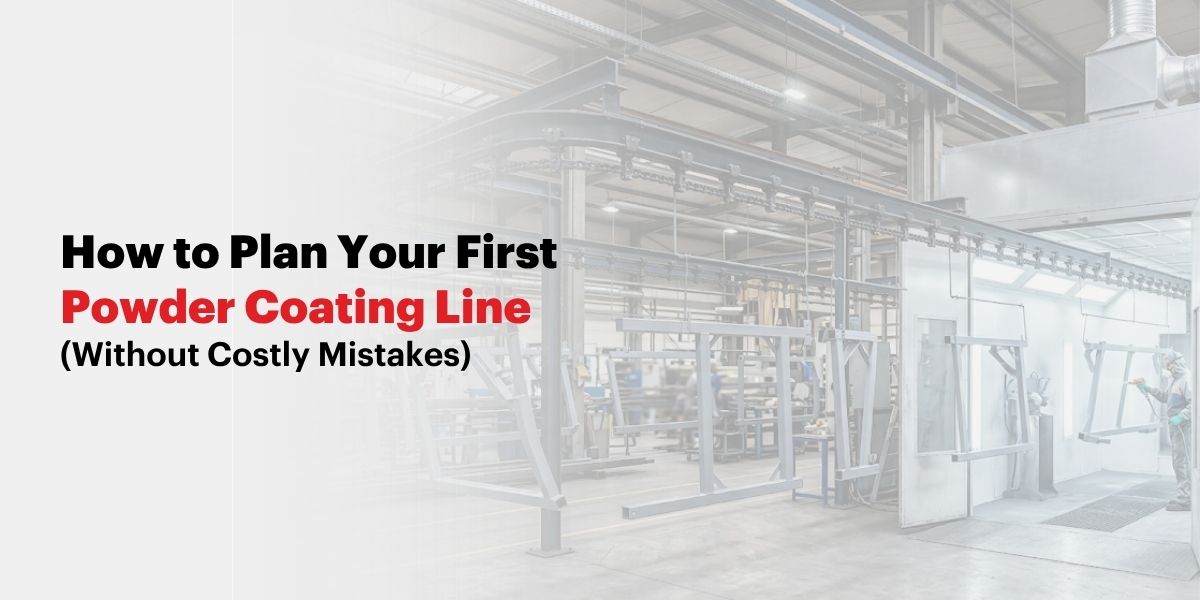
Setting up your first powder coating line is an exciting step. But it’s also where many businesses make decisions that lead to long-term inefficiencies.
At first glance, it may seem like a matter of selecting the right equipment like spray guns, booths, ovens.
In reality, a coating line is not just a collection of machines. It is a system where every stage must work in sync.
Poor planning at this stage often results in:
- Low productivity
- Inconsistent quality
- Higher operational costs
This guide will help you plan your first coating line the right way—with a focus on process, scalability, and efficiency.
1.Start with Your Production Goals (Not Equipment)
One of the most common mistakes is starting with: “Which machine should I buy?”
Instead, start with: “What output do I need to achieve?”
Define clearly:
- Daily production requirement
- Types of components
- Size and weight variations
- Batch vs continuous production
Why this matter:
Your entire line i.e. conveyor speed, oven size, layout – depends on your output requirement.
If you get this wrong, everything else becomes a compromise.
2.Design the Process Flow First
Before selecting equipment, define your process sequence:
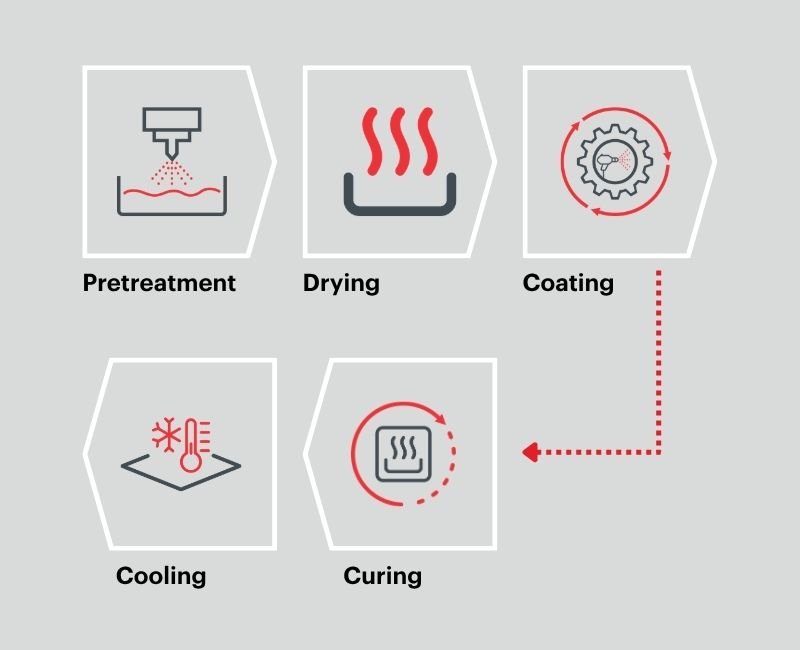
Pretreatment → Drying → Coating → Curing → Cooling
Key question:
Does your layout ensure smooth flow without
interruptions?
Watch out for:
- Backtracking of material
- Congestion at entry/exit points
- Unnecessary manual handling
A well-designed flow:
- Reduces delays
- Improves consistency
- Minimizes manpower dependency
3.Focus on Line Balancing (Critical)
Every stage in your coating line must operate at a compatible speed.
Common issue:
- Fast coating stage
- Slow curing stage
Result:
- Material accumulation
- Idle time
- Reduced output
What to ensure:
- Conveyor speed matches curing time
- No stage becomes a bottleneck
Balanced line = stable production
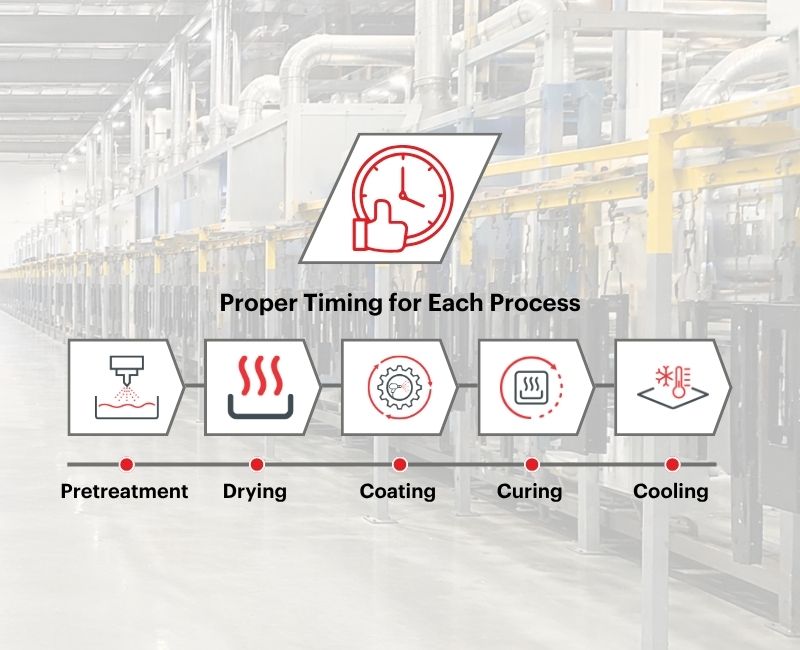
4.Get The Timing Right
Timing is one of the most overlooked aspects
in coating systems.
Critical parameters:
- Pre-treatment duration
- Drying time
- Curing cycle
What happens if timing is off?
- Too short – poor adhesion / defects
- Too long – energy waste / reduced throughput
Consistency comes from controlled timing, not trial and error
5.Plan for Scalability (Very Important)
Most coating lines work fine initially – but struggle when demand increases.
Ask yourself:
Can your line handle 2X production in future?
Common scaling issues:
- Conveyor limitations
- Oven capacity mismatch
- Space constraints
Design for tomorrow – not just today
6.Minimize Manual Dependency
Manual handling increases:
- Time
- Errors
- Inconsistency
Optimize for:
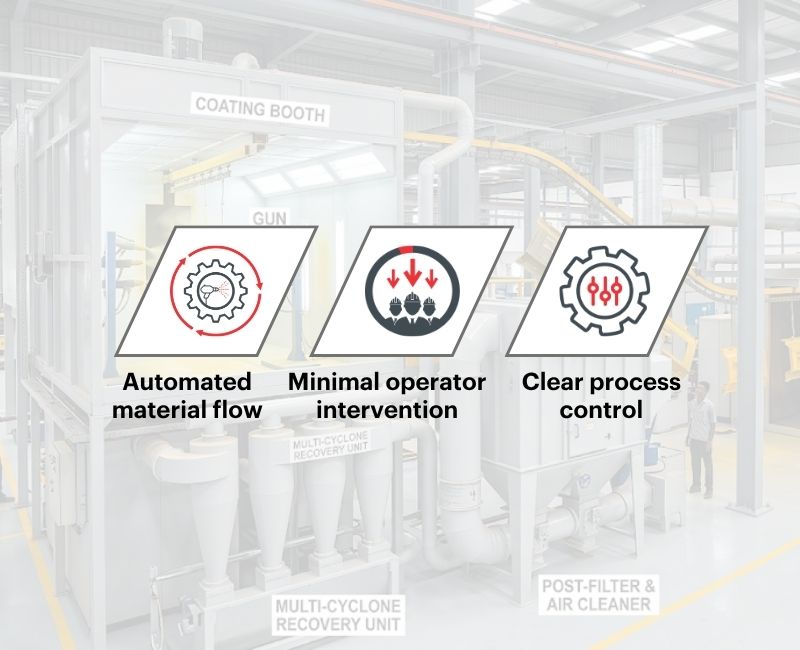
- Automated material flow
- Minimal operator intervention
- Clear process control
A good system should: Deliver consistent results regardless of operator
7.Avoid These Common Mistakes
- Selecting equipment before defining process
- Ignoring line balancing
- Underestimating space requirements
- Designing only for current capacity
- Over-relying on manual operations
These mistakes don’t show immediately – but become costly over time.
Conclusion
A successful powder coating line is not defined by the machines it uses, but by how well the entire system works together.
When planned correctly, your coating line will:
- Deliver consistent quality
- Achieve higher productivity
- Scale with your business
When planned poorly, it becomes a constant source of:
- Delays
- Rework
- Operational inefficiency
If you’re planning your first coating line, don’t just think in terms of equipment.
Think in terms of system design, flow, and long-term performance.
Need guidance on planning your coating line? Connect with experts who understand the complete system—not just individual machines.