


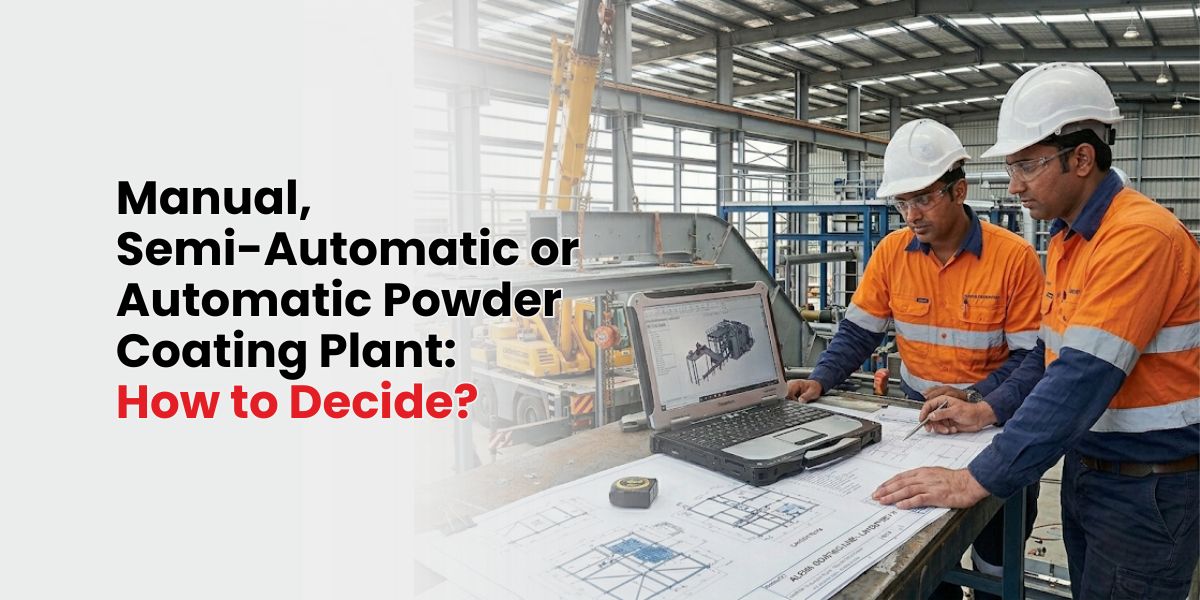
When manufacturers plan a powder coating plant, one question comes up very early.
Should the line be manual, semi-automatic, or automatic?
Many teams assume that automatic means better. Some choose manual because it looks cost-effective. But both decisions can go wrong if they are made without understanding the production reality.
A coating line should match the way the factory actually works.
The Common Mistake
The most common mistake is comparing systems only by price or automation level.
A fully automatic line may look advanced, but it may not suit a factory with changing component sizes, low batch volumes, or frequent colour changes. A manual line may look affordable, but it may create challenges in consistency, manpower dependency, and output speed later.
The decision should begin with the nature of production, not with the machine type.
The wrong line can become expensive, even if the quotation looks attractive.
When Manual Makes Sense
A manual powder coating setup works well when production is low, product variety is high, or component sizes keep changing.
It is also useful for trial batches, special components, large parts, or applications where flexibility is more important than speed. Operators can adjust their approach based on the component, surface, access area, and coating requirement.
However, manual systems depend strongly on operator skill and discipline.
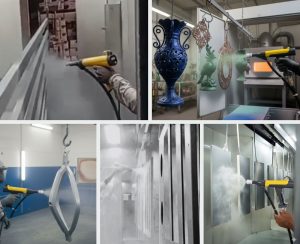
Manual systems work best when flexibility matters more than speed.
When Semi-Automatic Is the Middle Path
A semi-automatic line is often suitable for manufacturers who need better control but still handle product variation.
It can improve movement, reduce manual effort, and bring more consistency to the process without making the system too rigid. For many growing manufacturers, this becomes a practical balance between investment, flexibility, and repeatability.
Semi-automatic systems are useful when production is increasing, but the product mix is not completely standardized.
Semi-automatic lines offer control without losing flexibility.
When Automatic Becomes Necessary
An automatic powder coating line makes sense when production volumes are high, components are repetitive, and finish consistency is critical.
It helps reduce operator dependency, maintain uniform process flow, and support faster output across shifts. This is especially useful where customer expectations, delivery timelines, and rejection control are business-critical.
But automation delivers value only when the full process is planned properly.
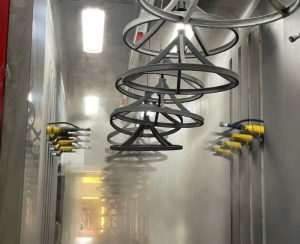
Automatic systems make sense when repeatability becomes business-critical.
A Simple Decision Checklist
Before choosing the system, ask:
- Is production repetitive or changing?
- Are volumes high or batch-based?
- Is finish consistency critical?
- How much does quality depend on operators?
- Will product size or volume change in future?
These answers make the decision clearer than simply asking whether the line should be manual or automatic.
Choose the line that matches how your factory actually works.
Manual, semi-automatic, and automatic powder coating plants all have their place. The right choice depends on production volume, component variation, quality expectations, manpower dependency, and future growth.
Choose the system that fits your production reality, not just your ambition.
Planning a powder coating plant and unsure which system is right for your production? Connect with Intech Surface Coating to discuss a coating line designed around your actual requirement.