

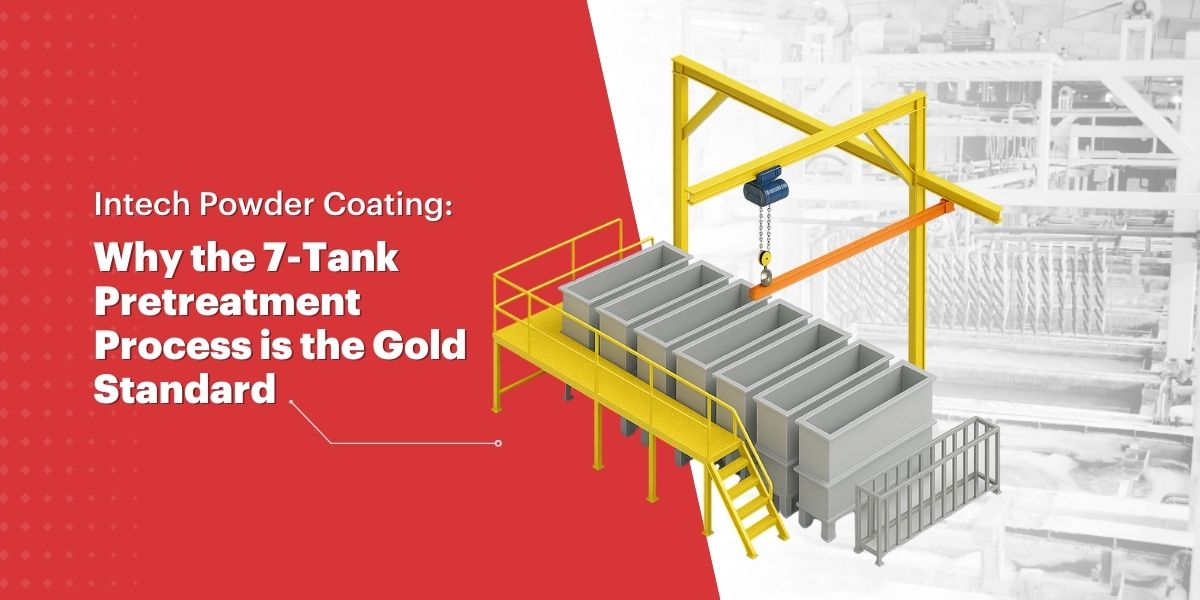
In powder coating, the finish is only as good as the foundation. A stunning color applied over a poorly prepared surface is a recipe for peeling, chipping and premature corrosion. That’s why at Intech, we don’t cut corners. Our commitment to durability begins with the industry’s most robust preparation method: the Phosphating Powder Coating 7 Tank Pretreatment process.
This isn’t just a cleaning step; it’s a comprehensive chemical transformation of the metal surface. For clients across India demanding finishes that withstand industrial, marine, or architectural challenges, this process is non-negotiable. Let’s break down why this meticulous approach sets the Intech standard apart.
Powder Coating 7 Tank Pretreatment process: A Step-by-Step Breakdown
Think of this process as constructing a perfect, adhesive-ready canvas. Each tank has a specific, critical role in ensuring the powder coating bonds permanently and performs flawlessly.
1 Stage: Alkaline Degreasing (Tank 1)
Purpose: To remove all organic contaminants oils, greases, shop dirt, and drawing compounds. These contaminants prevent any coating from adhering.
The Intech Detail: We use heated alkaline cleaners that saponify fats and suspend soils. This isn’t a simple wipe-down; it’s a thorough chemical bath ensuring the bare metal is exposed.
2 Stage: First Rinse (Tank 2)
Purpose: To remove the cleaning chemicals and any suspended soils from the surface. This prevents contaminating the next stage.
The Intech Detail: We use clean, overflowing water to ensure a complete rinse. Contamination carryover is a primary cause of pretreatment failure.
3 Stage: Derusting & Pickling (Tank 3)
Purpose: To dissolve rust, mill scale, and light oxides from the steel surface. This creates a uniformly reactive metal surface.
The Intech Detail: Using controlled acidic solutions, we remove corrosion products without excessively etching the base metal, preparing it for conversion coating.
4 Stage: Second Rinse (Tank 4)
Purpose: Critical neutralization. This step stops the acidic pickling reaction and rinses away residual iron salts.
The Intech Detail: Maintaining a neutral pH here is vital. We monitor this continuously to prevent acid from being dragged into the subsequent stages, which would spoil the phosphate coating.
5 Stage: Surface Activation (Tank 5 – The Secret Weapon)
Purpose: Often an optional step for others, but standard for Intech. This tank prepares the metal surface to form a fine-grained, dense phosphate crystal structure.
The Intech Detail: Activation creates nucleation sites on the metal. This results in a smoother, more uniform zinc phosphate layer that significantly enhances both corrosion resistance and powder adhesion.
6 Stage: Zinc Phosphating (Tank 6 – The Heart of the Process)
Purpose: This is where the chemical conversion happens. The steel surface reacts to form a hard, micro-crystalline layer of zinc phosphate that is integrally bonded to the metal.
The Intech Detail: This layer is not a paint; it’s part of the metal. It provides superb corrosion inhibition and creates a perfect mechanical “tooth” for the powder coat to lock onto.
7 Stage: Final Passivation & Rinse (Tank 7)
Purpose: To seal the phosphate coating. This chromate or chrome-free rinse closes the microscopic pores in the phosphate layer, boosting corrosion resistance and providing a clean, dry surface for powder application.
The Intech Detail: This final seal is what gives our coatings exceptional salt-spray ratings. It ensures the parts are immaculately prepared as they enter the powder booth.
The Tangible Benefits of Intech’s 7 Tank Process
Choosing a coater who invests in this full process means investing in your product’s longevity. The benefits are measurable:
Superior Adhesion:
The zinc phosphate crystal structure creates a physical anchor for the powder, virtually eliminating coating delamination.
Maximum Corrosion Resistance:
It provides a secondary barrier against rust, protecting the substrate even if the topcoat is scratched (enhanced cosmetic corrosion protection).
Consistent, High-Quality Finish:
Eliminates surface defects like fisheyes, craters, or orange peel caused by contaminated substrates.
Long-Term Durability:
For industrial equipment, architectural metalwork and automotive components in India, this process is what separates a 2-year finish from a 10+ year finish.
Ready for a finish defined by its foundation? Don’t settle for a coating that’s only skin-deep. Contact Intech today to discuss how our Powder Coating 7 Tank Pretreatment Process can deliver the durable, high-performance finish your metal products require.
FAQs: The Intech 7-Tank Powder Coating Process
Is the 7 tank pretreatment process really necessary? Can’t you just clean and coat?
For true industrial durability, yes, it is necessary. Simple cleaning removes dirt but does not protect the metal or enhance adhesion. The 7-tank process chemically alters the surface to actively prevent rust and create a permanent bond for the powder. For decorative items with mild exposure, shorter processes exist, but for performance, the 7-tank method is superior.
Why are there so many rinse stages? Doesn’t that just waste water?
Each rinse is a critical quality control step. It prevents chemical contamination from one stage to the next. Contaminant carryover is a leading cause of pretreatment failure. Our system is designed for efficiency, often incorporating water recycling and recovery to manage environmental impact responsibly.
What is the purpose of the Activation (Tank 5) stage?
Think of activation as “prepping the canvas.” It conditions the metal to grow a finer, denser, and more uniform phosphate crystal layer during phosphating. This results in a smoother surface with better corrosion resistance and stronger mechanical adhesion for the powder coat.
How does this process differ for different metals like aluminum or galvanized steel?
The core principles remain, but the chemistry adapts. For aluminum, we use a specialized chromate or titanium-based conversion coating instead of zinc phosphate. Intech technicians are trained to select and control the exact pretreatment chemistry required for your specific substrate.
My part is new and looks clean. Does it still need this full process?
Absolutely. “New” metal almost always has invisible oils (from machining or stamping), light oxides, and handling soils. The 7-tank process is designed to address both visible and invisible contaminants to guarantee a perfect, long-lasting bond.